
Conventional wisdom says flat feet need arch support. The research says something different. Here's what zero drop shoes actually do for flat feet.
Affiliate Disclosure: By clicking through the links on this page and purchasing the products, you’ll be helping me out. This is done because I receive a kickback from the sellers at no extra cost to you! Thank you so much for supporting us!
Conventional wisdom says flat feet need arch support. The research says something different.
If you have flat feet, you’ve probably been told the same thing your whole running life: you need motion control shoes, orthotics, and plenty of arch support. And if you’re curious about zero drop shoes, you’ve probably been told to stay away from them.
I’ve been on the other side of that conversation. I used to fit runners in a shoe shop, and when someone with flat feet came in, the script never changed — support, more support, an orthotic on top. Flat feet is also one of the topics readers email me about most. So here’s the honest answer I wish I could’ve given back then.
Here’s the thing — that advice is based on an outdated model of how feet work. And the evidence doesn’t support it.
Let me explain what zero drop shoes actually do for flat feet, what the research shows, and what you need to know before making the switch.
Why the Traditional Advice Exists (and Why It’s Wrong)
Traditional podiatry treats flat feet like a structural problem that needs external correction. Your arch isn’t holding up, so you add arch support to compensate. It’s intuitive. It’s also the same logic that led to motion control shoes, rigid orthotics, and decades of runners who never developed the foot strength to run comfortably without them.
The problem is that arch support does the job so your muscles don’t have to. Intrinsic foot muscles — the small muscles inside the foot that actually hold your arch up — atrophy when a supportive shoe does the work for them. Over time, you become more dependent on the support, not less. Your flat feet don’t get better. They get more reliant on correction.
Barefoot shoes work on the opposite premise: remove the crutch, strengthen the muscles, and let the foot do what it’s built to do. Simple idea — but does it actually hold up?
What the Research Actually Shows
A 2021 study from the University of Liverpool found that six months of daily activity in minimal footwear increased foot strength by an average of 57.4%. That’s not a small improvement — that’s a transformative change in the muscles responsible for arch function.
And it’s not a one-off finding. Multiple studies using MRI and ultrasound have measured significant increases in intrinsic foot muscle size and strength when people switch to minimal shoes — one well-known trial found that simply walking in minimalist shoes was as effective as dedicated foot-strengthening exercises. The muscles work harder because they have to. And working muscles get stronger.
For flat feet specifically, this matters enormously. The arch isn’t just a bony structure — it’s largely a dynamic system supported by muscles, tendons, and fascia. A flat arch can become a stronger arch when the muscles are trained. Barefoot shoes are, effectively, a training program for your feet.
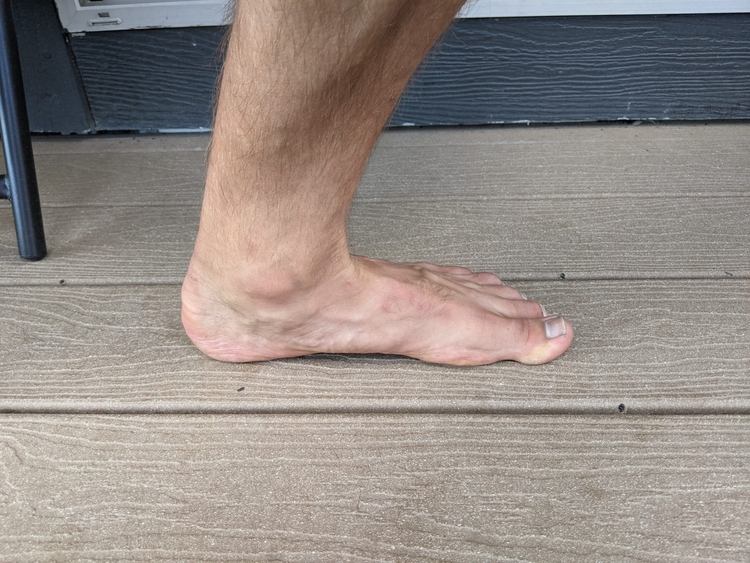
There’s an important distinction here, though. For most people, flat feet are “flexible” — the arch appears when you sit with your foot off the ground and flattens under load. That kind of arch responds well to training. A smaller number of people have rigid flat feet, where the bones themselves are fixed in place. That’s a genuine structural issue, and a reason to get a professional opinion before you change anything.
Yes, But Carefully
So should you toss your orthotics and run a marathon in a 5mm-stack shoe tomorrow? Absolutely not. That would be a disaster.
The transition to zero drop shoes with flat feet needs to be conservative — and the standard transition protocol applies especially strongly here:
- Start with 10-15 minutes of walking or very easy running in the new shoes
- Build no more than 10% additional time each week
- Do the short foot exercise twice daily — it directly targets the intrinsic muscles that support your arch
- Monitor for arch fatigue in the first six to eight weeks
- If you’re using orthotics, consider working with a physio to assess your baseline arch function before reducing support
The short foot exercise deserves its own emphasis. It’s the single most effective thing you can do to build the muscles that zero drop shoes will demand. If you’re not doing it, your transition will be slower and harder.
It’s simple to learn. Sit with your foot flat on the floor and your toes long and relaxed, then draw the ball of your foot back toward your heel — shortening the foot and lifting the arch without curling your toes. Hold for five seconds, release, and repeat. Two sets of ten, twice a day. It’s worth pairing with a few other foot-strengthening drills to build the foundation faster.
What to Expect
What does a successful transition actually look like? Not necessarily a higher arch — your feet may never develop one, and that’s fine. The goal is functional strength: the ability to run comfortably without external support.
For most flat-footed runners, the outcome that matters isn’t a prettier arch — it’s that their feet stop hurting. Many do report their arches becoming visibly more defined after months of barefoot shoe use. But the rolling, the pain from overpronation, the knee and hip aches that can cascade upward from unsupported flat feet — those are what tend to improve when the underlying muscles get stronger.
It takes time. Most runners with flat feet need six months or more before they feel confident running without their orthotics. Some keep using minimal support for longer runs and go fully barefoot-style for shorter efforts. That’s fine. From the readers who write to me, the ones who are happiest a year on are never the ones who rushed it. The ones who struggled? Almost always the ones who did.
Which Zero Drop Shoes Work Best for Flat Feet
For flat-footed runners, I’d prioritise three things:
Wide toe box — Your foot needs room to function. A narrow toe box undermines everything you’re trying to achieve by stopping the toes from splaying naturally. (New to this? My guide on how a barefoot shoe should fit is worth a read first.)
A roomy midfoot — This matters more for flat feet than most people realise. A flat foot sits wider and lower through the arch, so a shoe that’s snug across the midfoot presses on exactly the part that’s already working hardest. Room around the arch lets it move.
Enough stack to ease in, plus a flexible sole — You don’t need to jump straight to a 5mm minimal shoe. Something in the 9-14mm range gives you zero drop with enough cushioning to take the edge off the transition — and the sole still needs to bend when your foot bends.
Three shoes I’d point flat-footed runners toward:
Bahe Revive Modes — The clever one. It ships with three interchangeable zero-drop soles: Flex (10mm), Adapt (14mm) and Endurance (22mm). You can start with more cushioning while your feet are weak and dial it down as your intrinsic muscles strengthen — a transition shoe that transitions with you. It’s the priciest of the three, but you’re effectively buying three setups in one.
Freet Vibe 2 — My pick if midfoot room is your priority. At 10.5mm zero drop it sits right in the transition-friendly range, and Freet’s roomy midfoot gives a flat foot somewhere to spread without the shoe fighting it. Wide toe box, snug heel, flexible — and noticeably gentler on the wallet than the Bahe.
Xero Shoes Prio — The budget pick, and a proven one. At 5mm it’s the most minimal of the three, so it suits you best once you’ve already done some adapting — or if you want maximum ground feel and the lowest price from the start. Zero drop, wide toe box, flexible.
The Bottom Line
Zero drop shoes aren’t just safe for flat feet — they address the underlying cause instead of just managing the symptoms. Arch support treats the consequence. Barefoot shoes train the cause.
The transition is real, and it requires patience. But six months from now, your feet could be genuinely stronger — not just propped up by a foam insert that keeps you dependent.
If you’re mid-transition with flat feet and something isn’t going to plan, email me. It’s genuinely one of my favourite questions to help readers with.
Personal disclaimer: I’m Nick, a UESCA-certified running coach who has been running in barefoot and minimalist shoes for years. I’m not a podiatrist or a doctor. If you have a diagnosed condition or significant pain, consult a physio before changing your footwear.