
A $120 barefoot sandal looks like a strip of rubber and some string. Here's why that price is real, and how to actually judge if it's worth it.
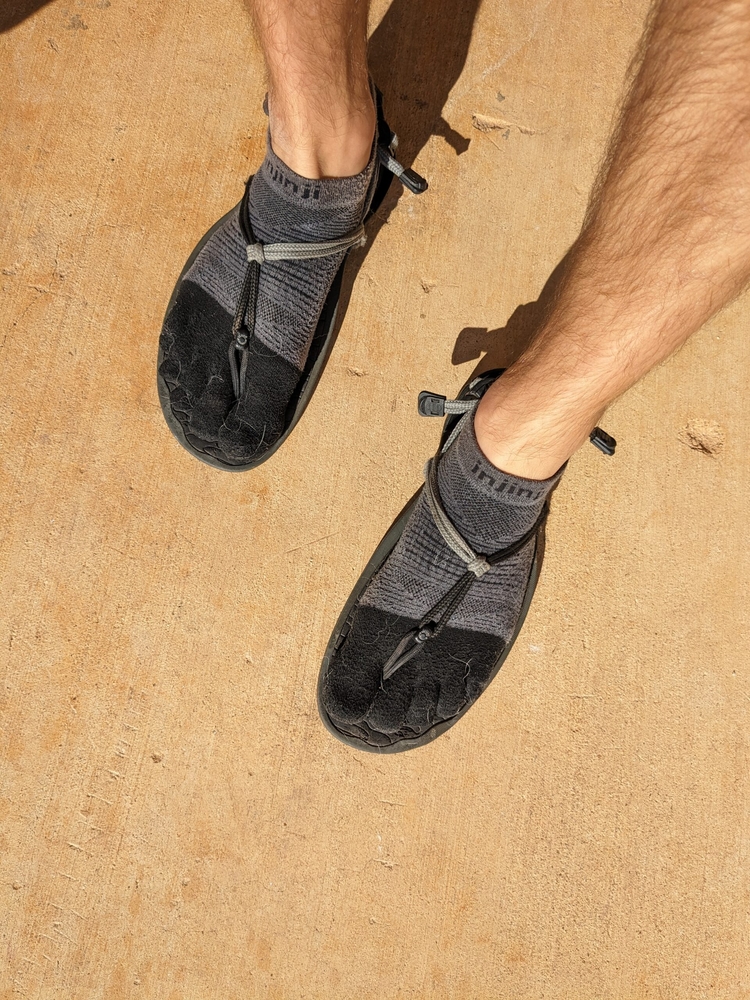
“It’s literally just a sole and some string. Why does it cost $120?” I’ve seen this question a dozen times in barefoot running communities, and it’s a fair one to ask — it’s just asking about the wrong thing.
This isn’t a one-off complaint, either. It’s the kind of debate that comes up again and again: someone posts about the price, someone else pushes back, and neither side is entirely wrong. The materials really are minimal. The price really is justified. Here’s why both of those are true at once.
The Scale Problem Is Real
Barefoot sandals aren’t mainstream, and that alone drives the price up. A shoe brand pumping out millions of units a year gets economies of scale a niche sandal maker never will — every material order and shipping container gets cheaper per unit the bigger the order is. A sandal maker working in small batches doesn’t get any of that leverage; they’re paying closer to retail for the same inputs a big brand buys at wholesale, at a fraction of the volume.
Some sandals are hand-manufactured, too, often in regions where labor genuinely costs more than a mass-market factory line. Neither of those is a markup story. That’s just what it costs to make something by hand, in small batches, for a market that’s still tiny.
So yes — $120 is a high price. I’m not going to pretend it isn’t. It’s just not brands padding their margins.
Stop Talking About the Materials
Here’s where most people get this backwards: they think the cost is about the materials, and it isn’t. A sole and a strap doesn’t sound expensive because it isn’t expensive to make — and that’s exactly the wrong thing to be evaluating.
I’ll be specific rather than talk about “sandals” in the abstract: the well-made sandals I’ve tested — Earth Runners and Xero Shoes — have lasted a lot longer than full shoes in my experience. That’s not a law of the category, it’s mechanical. A shoe’s upper is stitched, layered, and built to hold your foot in place — and it can blow out on one side, at which point the shoe is basically done even if the outsole has life left. A well-made sandal’s “upper” is just strapping. There’s nothing to blow out. But that logic only holds if the sandal is actually well-built to begin with — a cheap sandal from a brand I haven’t tested could fail in ways I haven’t seen.
So the materials-cost argument is a red herring. The value is in what you’re getting over time, not in what the product is made of on day one.
What I’ve Actually Tested
I’ll be upfront here — I haven’t tested a huge range of barefoot sandals. Earth Runners and Xero Shoes are the two I have real experience with, and I’m not going to generalize beyond what I’ve actually worn. There are more brands entering this space every year, and I’d genuinely like to get more of them on my feet — but I’d rather tell you honestly what I do and don’t know than pad this out with secondhand impressions of sandals I’ve never actually strapped on. If you’ve worn a brand I haven’t mentioned, that’s useful information for me too.
How to Actually Judge the Price
Look at what you get for the money, not the number on the price tag. Say a budget sandal costs $30 and needs replacing every six months — that’s $60 a year. A well-made $120 sandal that lasts two years works out to $60 a year too, but you’re getting a better-built product the whole time you own it. Push that same sandal to three years, and the cost-per-year drops to $40 — cheaper than the budget option. The sticker price and the real cost are two different numbers, and only one of them matters.
There’s a real caveat, though: if you live somewhere cold for a big chunk of the year, sandals aren’t the right call for you. None of this cost-per-use logic applies if you’re not getting the usage that makes the higher price worth it — that’s not a flaw in the product, just a mismatch with your climate.
The Bottom Line
Next time you see that price tag and your gut reaction is “for that?”, ask the better question instead: how long is this actually going to last me, and how often will I actually wear it? That’s the only version of this question that gets you a useful answer.
Choose barefoot sandals if:
- You run, walk, or train in conditions warm enough to make sandals practical year-round or for most of the year
- You want maximum ground feel and are comfortable with minimal foot protection
- You value long-term durability over a lower sticker price
Skip them if:
- You live somewhere cold for a large part of the year and won’t get consistent use out of them
- You’re expecting them to cost the same as a basic pair of flip-flops — they’re a different, more durable product entirely
If you’re convinced by the math and want to actually try this, Earth Runners and Xero Shoes are where I’d point you first — a real, tested starting point rather than a guess.
Have you tried Earth Runners or Xero Shoes sandals? I’d love to hear how they’ve held up for you — share your experience!